
What Works?
In What Context?
Under What Circumstances?
Why?
by Nthanda Manduwi [Author] | Book 7 of 7: Lessons
A New Normal is a systems book about what comes after development-as-usual.
After tracing failure, power, dysfunction, impossible economies, denial, and the quiet wars that still shape the Global South, Nthanda Manduwi turns towards the work of building. The book asks what countries, institutions, entrepreneurs, and communities can do when knowledge is more available than ever, but execution under constraint remains the central challenge.
Nthanda writes from the vantage point of a Malawian systems thinker who has moved through government, international development, entrepreneurship, evaluation, and technology. Her perspective is shaped by work within the United Nations system, World Bank-supported programmes, African entrepreneurship ecosystems, and her own efforts to build organisations across infrastructure, creativity, community, and artificial intelligence. The book brings that range into a practical question: how do we build systems that can actually work where resources are limited, institutions are strained, and old development models have reached their limits?
A New Normal begins with the recognition that the world is no longer organised around the same knowledge hierarchy. A student in Blantyre can access lectures, research, tools, and models once concentrated in elite institutions. Entrepreneurs in Lilongwe can build with technologies that previous generations could not reach. Artificial intelligence is changing the relationship between knowledge, labour, design, and execution. The old excuse of information scarcity is losing force.
Yet access to knowledge does not automatically create transformation. Countries still need infrastructure that works, energy that holds, supply chains that move, farms that produce, cities that function, institutions that learn, and systems capable of turning ideas into outcomes. The book focuses on that gap between knowing and doing.
Across its pages, A New Normal looks at infrastructure, AI, execution, institutional design, community systems, production, mobility, agriculture, education, and the future of the Global South. It is constructive without being naïve. It treats technology as a tool, not a miracle. It treats ambition as necessary, but insists that ambition must be organised into systems that can survive real constraints.
For policymakers, entrepreneurs, development professionals, technologists, students, institution-builders, and globally minded readers, A New Normal offers a way to think beyond critique. It asks what comes after diagnosis. It points towards a future where the Global South builds from its own realities, with institutions designed for learning, infrastructure designed for use, and technologies applied to problems people actually live with.
This is the final book in the Lessons Series: a movement from understanding what is broken towards building what can hold.
Read more about the Lessons Book Series: lessonsbooks.com
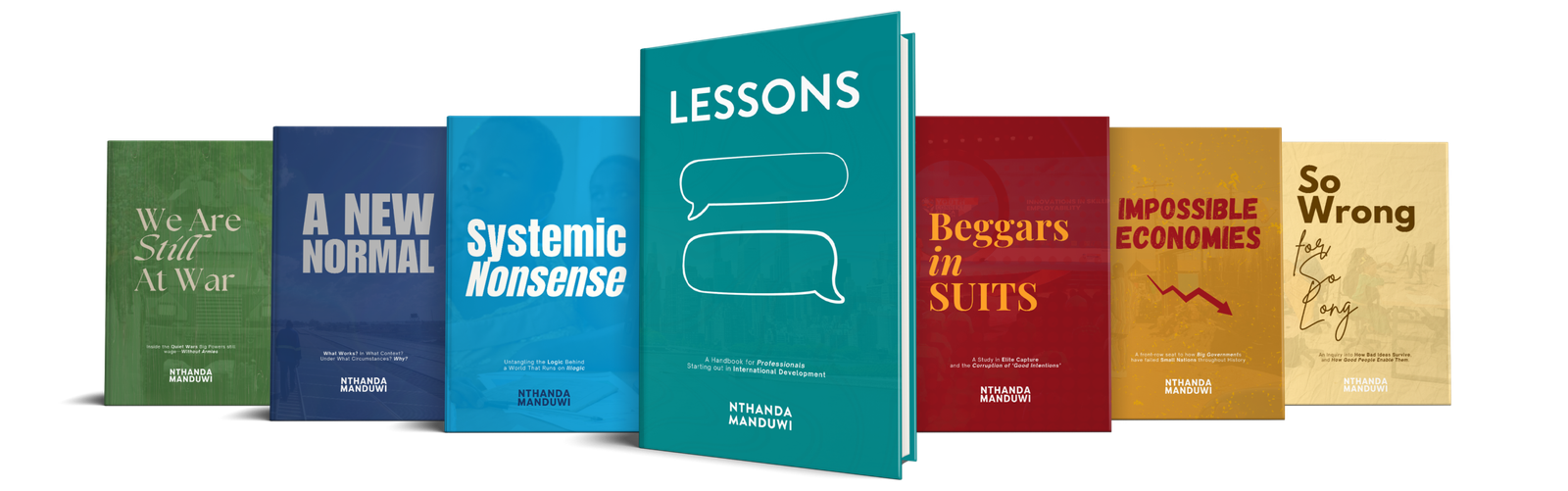
Explore the full series: