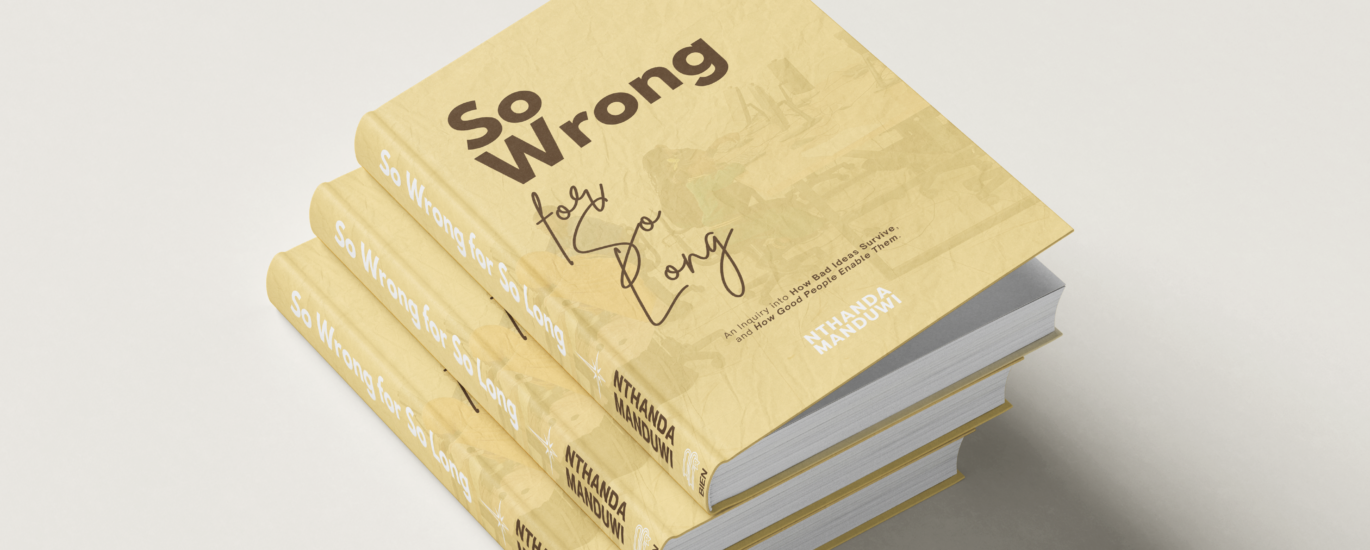
An Inquiry into How Bad Ideas Survive,
and How Good People Enable Them
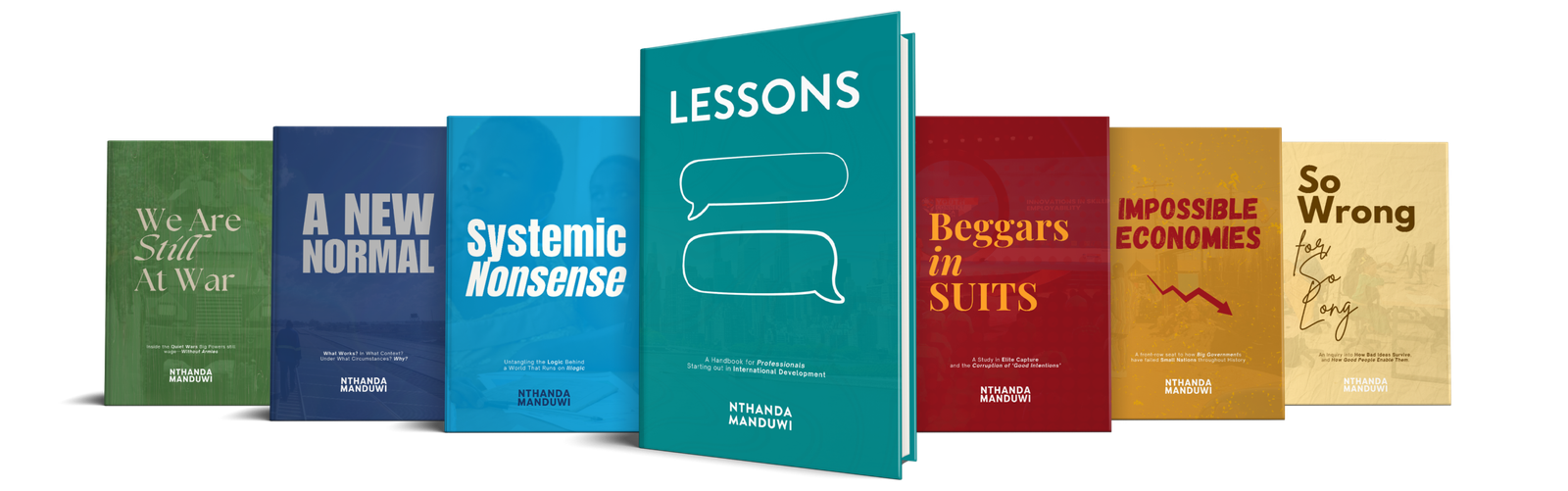
by Nthanda Manduwi [Author] | Book 5 of 7: Lessons
So Wrong for So Long follows the habits that make failure survivable: the language, incentives, reporting systems, professional silences, and institutional routines that allow weak ideas to continue after evidence has arrived.
Written after Nthanda Manduwi’s work within evaluation and development systems, including the United Nations Development Programme’s Independent Evaluation Office in New York, the book brings institutional proximity to one of development’s most difficult questions: why do bad ideas survive so long after their limits become visible?
The book begins with the ordinary life of failure. Policies outlive their usefulness. Programmes continue because too many budgets, careers, and reputations have gathered around them. Reports document recurring weakness while decision systems remain unchanged. Workshops, missions, strategies, and evaluations create the appearance of learning while the underlying direction stays familiar. Professionals learn which truths can be said plainly, which must be softened, and which should be left for another meeting.
Nthanda writes with respect for the people inside development institutions. The book recognises their intelligence, commitment, and constraints. It also studies the systems that teach good people to survive failure more effectively than they correct it. In that tension, So Wrong for So Long becomes one of the clearest books in the series: a study of denial as an institutional skill.
The book moves through policy fossilisation, development without development, psychological survival, fear of change, complicity, acknowledgement, course correction, and institutional learning. It asks what it takes for failure to become useful rather than permanent. It treats learning as architecture: protected feedback, contestable authority, adaptive incentives, operational memory, and the courage to let evidence change what the system is allowed to do next.
For readers interested in evaluation, public policy, institutional reform, international development, governance, organisational learning, and systems change, So Wrong for So Long offers a precise language for a familiar frustration: the gap between what institutions know and what they are willing to change.
This is a book for anyone who has watched a weak programme receive another phase, a failed model acquire new branding, or a difficult truth disappear into careful language. It gives readers a way to understand how failure becomes durable, and why denial remains one of the most expensive habits in public life.
Read more about the Lessons Book Series: lessonsbooks.com
Explore the full series: